
Bulgaria Company Capital Increase:
Revolut & EU Bank Accounts Now Accepted
If you're an EU SaaS, agency, or e-commerce founder, you understand that the challenge goes beyond tax rates. The real obstacle is operational friction.
High-tax jurisdictions erode your margins, but administrative and banking friction consumes your time. When you're building a lean, scaling team, time becomes your most valuable and irreplaceable resource.
This explains why founders consistently ask these questions:
The Questions We Hear Every Week
The answer is encouraging: Bulgaria is evolving in the right direction. Recent real-world cases demonstrate that the Bulgarian Company Register has begun accepting capital increases funded through EU bank accounts opened outside Bulgaria — including modern fintech solutions.
Why This Development Matters for Digital Founders
Historically, many founders encountered significant obstacles at a specific stage: capital-related corporate actions.
In Bulgaria, certain company procedures require documented proof that capital was properly transferred. In practice, this requirement often forced founders to open a Bulgarian "capital raising" or escrow-style bank account first — even when they intended to manage most financial operations through EU fintech platforms later.
This process frequently caused delays, particularly for founders in regulated industries, "high-risk" sectors, or anyone whose business profile triggered enhanced due diligence from traditional banks.
EU Fintech Accounts Now Accepted by the Bulgarian Company Register
A Bulgarian law firm recently confirmed successful registration of a capital increase where the contribution came through an EU licensed credit institution account opened outside Bulgaria. Historically, the Register had accepted contributions only through Bulgarian banks. This development creates real opportunities for EU fintech solutions — including Revolut — in official Register proceedings.
For founders, this signals Bulgaria's growing alignment with EU single market realities: you should be able to leverage EU banking services across borders when documentation meets requirements.
What This Changes for Your Business Operations
Reduced Friction During Growth Phases
Founders don't simply "set up and forget" their company structures. They scale operations, bring in investors, increase capital, and restructure ownership. When capital-related actions become easier to execute using EU banking infrastructure, this supports sustainable growth — and more importantly, speed: the actual currency that matters in SaaS and performance-driven e-commerce.
It Enables Modern Founder Finance Stacks
Your target profile operates using fintech and payment service providers — not because it's fashionable, but because it's operationally efficient. Bulgaria already functions within the EU legal and financial framework. What founders need is the ability to operate normally with the tools they already use, rather than "downgrading" their systems just to access low corporate tax rates.
It Confirms a Larger Trend: EU Transparency Is Expanding
This development connects to a broader regulatory shift: CESOP. Many founders assume they can reduce regulatory scrutiny by changing payment providers or banking relationships. That's not the direction EU policy is moving — the EU is implementing the opposite approach: increasing financial transparency.
CESOP: Your Payments Are Already Being Reported
CESOP is an EU-wide system designed to combat VAT fraud in cross-border e-commerce. It requires payment service providers to collect and report specific cross-border payment data automatically.
If your business exceeds this threshold, the relevant transaction data is automatically transmitted to EU tax administrations — including Bulgaria's National Revenue Agency, which has published official guidance on these reporting obligations effective from January 1, 2024.
This applies regardless of which payment provider you use:
Using any of these doesn't eliminate reporting obligations — reporting is now embedded into the EU regulatory system. The winning approach isn't avoiding visibility. It's establishing proper structure and maintaining compliance from day one.
Why This Combination Makes Bulgaria More Compelling
More Fintech-Friendly
Capital actions now function with EU bank accounts opened outside Bulgaria, removing a traditional obstacle for international founders.
EU Reporting Standardized
CESOP clarifies that cross-border payment data is already integrated. Your advantage comes from proper compliance, not reduced visibility.
Flat Tax Structure
10% corporate tax + 10% personal income tax + 5% dividends. Predictable margins that let you reinvest and scale with confidence.
Capped Social Contributions
Unlike France, Germany or Belgium — Bulgaria's social contributions are capped, making hiring and payroll genuinely manageable.
Founder Takeaway: The New "Low-Risk" Approach is a Compliant EU Structure
Many founders hesitate because they anticipate complexity. What they actually want is a system where:
- Tax obligations are predictable and transparent
- Banking operates like the rest of the EU
- Reporting requirements are handled correctly from day one
- They can scale without constant concern about compliance mistakes
This is precisely how to position Bulgaria: not as an offshore solution or a tax "trick" — but as a modern EU base specifically designed for digital business operations. The goal isn't finding loopholes. It's building a sustainable, fully compliant EU structure that maximizes your reinvestment capacity while minimizing operational friction.
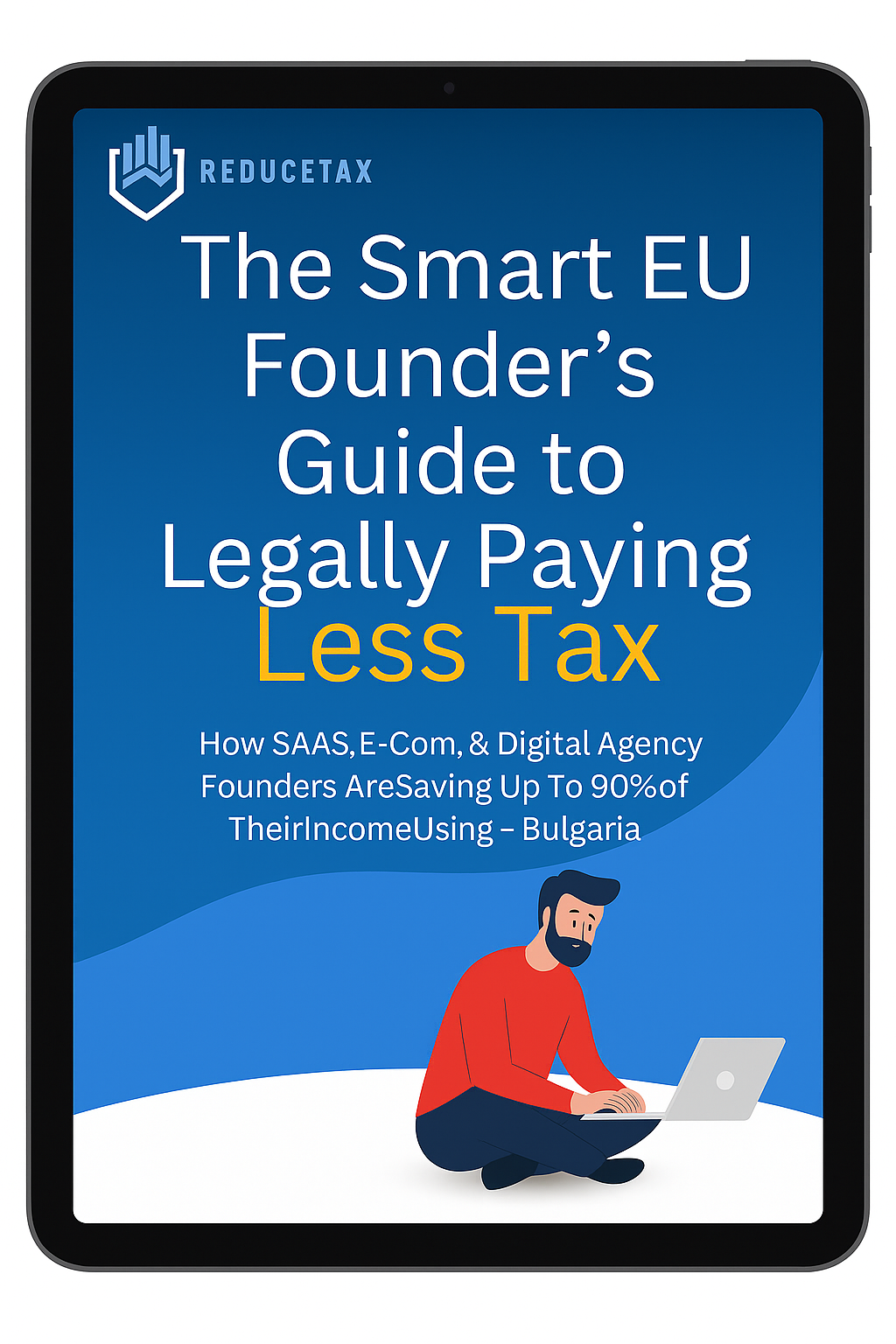
The Smart EU Founder's Guide to Legally Paying Less Tax
If you're an EU founder in France, Germany, Belgium or another high-tax country, you might be giving away up to 60% of your profits without realising it.
- Why hundreds of EU founders are moving to smarter tax structures
- How Bulgaria's 10% corporate tax can transform your margins
- Two proven, legal paths to cut taxes without disrupting operations
Ready to Build a Compliant EU Structure?
Book a free 30-minute consultation where we'll map a compliant setup based on your country of origin, business model, and payment stack.
We specialize in helping European businesses legally reduce their tax burden through strategic relocation to Bulgaria and other low-tax EU jurisdictions. Our team of tax professionals and legal experts ensures compliant, effective tax optimization solutions — from company formation to ongoing advisory support.
www.reducetax.eu